

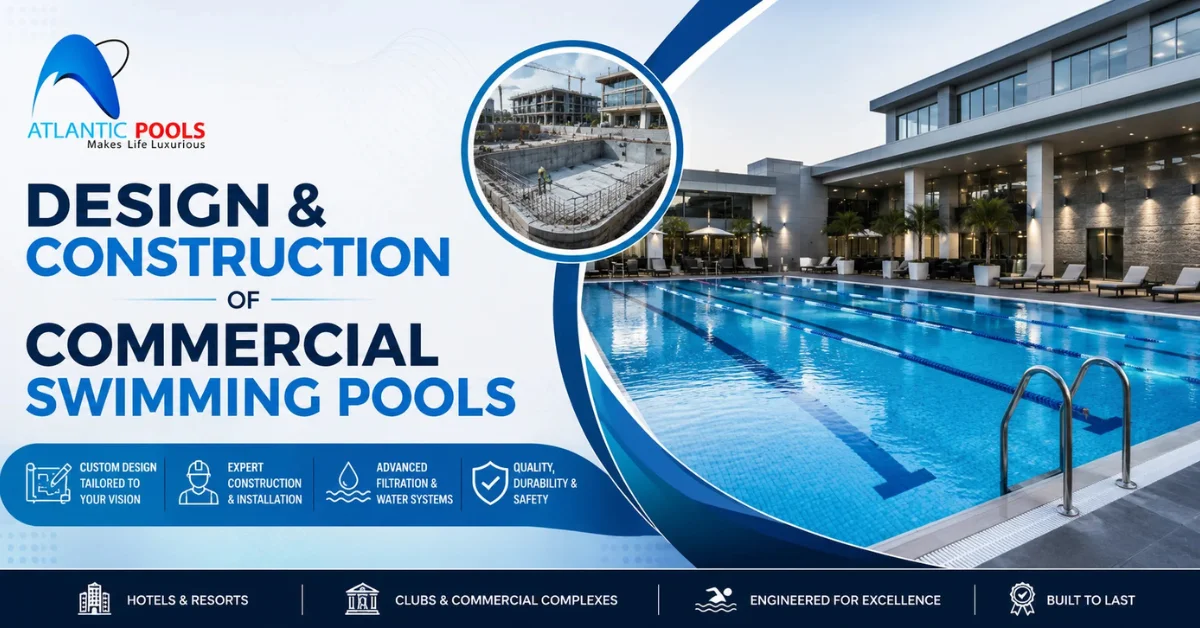
A hotel pool that draws guests to the terrace. A school pool that survives a hundred laps a day for twenty years. A community pool that never turns cloudy no matter how many families use it. None of this happens by accident — it happens because commercial swimming pool design and construction was treated as the serious engineering discipline it actually is, not as an oversized version of a backyard pool.
Commercial pools carry different demands than residential ones: heavier daily bather loads, continuous filtration, stricter safety codes, and a much higher cost of getting something wrong. This guide breaks down exactly what goes into commercial swimming pool design and construction — from the first site visit to the day the water gets tested — so you know what to expect before committing to a builder.
What Makes Commercial Pool Design Different From Residential
The biggest misconception in commercial swimming pool design and construction is that it’s simply “a bigger residential pool.” It isn’t. A backyard pool might see a handful of swimmers on a good weekend. A hotel or school pool can see hundreds of bathers a week, every week, for decades. That difference changes almost every engineering decision.
Load Capacity & Structural Engineering
Water is heavy — close to 1,000 kg per cubic metre — and a commercial pool shell has to carry that load plus the structural stress of constant use without cracking, shifting, or leaking. This means deeper foundation work, reinforced concrete shells, and structural calculations carried out by qualified engineers, not estimated on-site. Any commercial swimming pool design and construction project that skips this step is building in a problem that will surface within a few years.
Filtration and Water Treatment at Scale
A commercial pool filtration system typically runs around the clock. High-throughput sand filters, UV sterilisation, and automated chemical dosing aren’t upgrades — they’re baseline requirements. Poor filtration in a public or semi-public pool isn’t just an aesthetic problem; it’s a health and liability issue that can shut a facility down.
The Design Phase: Getting It Right Before Construction Begins
Site Assessment & Feasibility
Every serious commercial swimming pool design and construction project starts with a proper site assessment — soil testing, drainage evaluation, and a realistic look at access for heavy machinery and materials. Skipping this stage is one of the most common reasons commercial pool projects run over budget once excavation is already underway.
3D Visualisation & Layout Planning
Before a single shovel goes into the ground, a good design team will walk you through 3D renderings of the finished pool — depth zones, deck layout, lighting, and how the pool integrates with the surrounding building or landscape. This step matters more for commercial pool projects than residential ones, since stakeholders (hotel management, school boards, HOA committees) usually need to sign off on a design before construction can proceed.
Step-by-Step: The Construction Process
Commercial swimming pool design and construction moves through several distinct phases, each requiring different trades and sign-offs:
- Design & approvals — concept drawings, structural calculations, and any required permits.
- Excavation — site clearing and earthworks sized for the pool’s footprint and depth zones.
- Structural works — foundation slab, steel reinforcement, and shell construction (gunite, fibreglass, or vinyl liner).
- Plumbing & mechanical installation — pipe layout, pump room, filtration, and chemical dosing systems.
- Electrical works — lighting, control panels, and safety earthing.
- Finishing — tiling or plaster coat, coping stones, deck surfaces, and any water features.
- Commissioning — water fill, chemical balancing, and full mechanical testing before handover.
Timelines vary by scale, but most commercial projects take anywhere from three to six months from groundbreaking to commissioning, with permit approvals and imported equipment lead times being the most common sources of delay.
Choosing the Right Pool Shell Type
One of the earliest — and most consequential — decisions in any commercial swimming pool design and construction project is the shell material. Getting this choice right early avoids expensive rework later, since each option trades off differently on durability, customisation, and cost:
| Shell Type | Durability | Design Flexibility | Typical Use Case |
| Gunite / Shotcrete | Excellent — decades of service life | Fully customisable shape and depth | Hotels, schools, competition pools |
| Fibreglass | Very good, factory-sealed finish | Limited to pre-molded shapes | Smaller commercial or community pools |
| Vinyl Liner | Moderate — liner replacement needed periodically | Moderate flexibility | Budget-conscious community or club pools |
For most commercial applications — especially those with heavy daily use — gunite remains the standard choice because it can be engineered to the exact structural and shape requirements of the site, and it holds up best under continuous bather load.
Read More: Latest Swimming Pool Tile Designs in Lahore
Standards & Compliance
Serious commercial swimming pool design and construction is built to standards, not guesswork. Public health guidance from the World Health Organization governs safe water quality in shared pools, while competition-grade facilities follow World Aquatics (FINA) specifications for lane widths, depths, and timing infrastructure. On the structural side, engineering should follow recognised civil codes, and it’s worth confirming your builder’s technical team holds credentials verifiable through the Pakistan Engineering Council.
Cutting corners on compliance rarely saves money. A pool that fails a health inspection or develops structural issues two years after opening costs far more to fix than it would have cost to build correctly the first time.
Common Pool Mistakes to Avoid
Even well-funded commercial swimming pool design and construction projects run into avoidable problems. The most frequent ones we see:
- Undersized filtration — sized for the pool’s volume rather than its actual expected bather load.
- Skipping soil testing — leading to foundation issues that only appear after the pool is in use.
- Treating design and construction as separate contracts — which creates finger-pointing when something goes wrong, since no single party is accountable for the whole project.
- Choosing the lowest quote without an itemised breakdown — a red flag that usually means shortcuts somewhere in the structural or mechanical work.
- No maintenance plan at handover — a commercial pool that isn’t serviced correctly from day one degrades far faster than one that is.
Why Atlantic Pools is the Best Option for Your Project
Atlantic Pools manages commercial swimming pool design and construction under one accountable team — from the initial site visit through structural engineering, mechanical installation, and finishing, all the way to ongoing maintenance after handover. That single point of accountability is what prevents the fragmentation that causes so many commercial pool projects to run late or over budget.
Our team has delivered pool projects across Lahore, and every project follows the same discipline: proper structural calculations, filtration sized to actual usage, and finishes built to last well beyond the warranty period. If your project also calls for complementary features, we handle steam and sauna rooms, waterfalls and fountains, and mosaic tile work as part of the same build.
Final Thoughts
Commercial swimming pool design and construction is not a project to hand to whichever contractor offers the lowest number. The gap between a pool engineered correctly and one that wasn’t shows up in year two or three — cracked tiles, cloudy water, failing pumps, or worse. Getting the structural engineering, filtration sizing, and compliance right from day one is what determines whether your pool becomes a long-term asset or a recurring expense.
If you’re planning a hotel, school, or community pool project, get in touch with Atlantic Pools for a site assessment and a detailed, itemised quotation.
FAQs
What is involved in commercial swimming pool design and construction?
It covers site assessment, structural engineering, shell construction, mechanical and electrical installation, finishing work, and commissioning — typically managed across three to six months depending on project scale.
How is a commercial pool different from a residential one?
Commercial pools are engineered for much higher bather loads, requiring reinforced structural shells, continuous-run filtration systems, and compliance with public health and safety standards that residential pools don’t need to meet.
What shell type is best for a commercial pool?
Gunite (shotcrete) is the most common choice for commercial projects because it can be fully customized to the site’s structural and design requirements and holds up well under continuous use.
How long does commercial pool construction take?
Most commercial projects take three to six months from groundbreaking to commissioning, though permit approvals and imported equipment can extend the timeline.
Does Atlantic Pools handle both design and construction?
Yes. Atlantic Pools manages commercial swimming pool design and construction under one team, from feasibility and structural engineering through to finishing and ongoing maintenance.