

Every swimming pool depends on one piece of equipment more than any other: the filter. It runs quietly in the background, pulling out dirt, debris, and microorganisms so the water stays clear and safe to swim in. Choosing the wrong swimming pool filters — or the right filter sized incorrectly — is one of the most common reasons pool owners end up with cloudy water, high chemical bills, or a system struggling to keep up with use.
This guide walks through the main types of swimming pool filters, what each one is good at, and how to choose the right one based on your pool’s size, usage, and budget — whether it’s a private backyard pool or a high-traffic commercial facility.
Why Swimming Pool Filters Matter
A pool’s filtration system constantly cycles water through the filter, pump, and back into the pool — typically turning over the entire volume every 6 to 8 hours. Without a properly sized filter, sanitisers have to work much harder to keep water safe, algae growth accelerates, and fine debris keeps recirculating instead of being removed. Getting swimming pool filters right isn’t a minor detail — it’s the foundation everything else in water quality depends on.
Types of Swimming Pool Filters
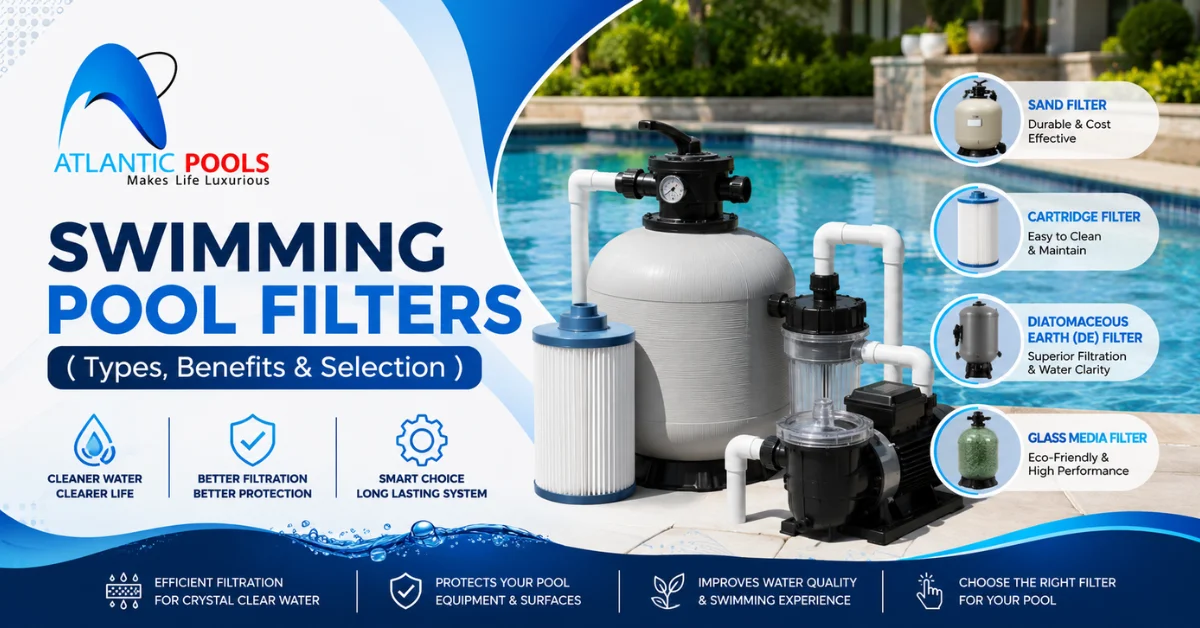
There are three main categories of swimming pool filters, and each one filters water differently, at a different level of fineness, and with different maintenance demands.
Sand Filters
Sand filters are the most common choice for both residential and commercial pools, largely because they’re durable, low-maintenance, and cost-effective to run. Water passes through a bed of specially graded sand, trapping particles as small as 20–40 microns. Within sand filters, a few construction variations are worth knowing:
- Injected sand filters — built using high-quality moulded materials for long-term durability with minimal upkeep.
- Laminated sand filters — a layered construction that adds structural strength while keeping filtration consistent.
- Blown sand filters — lightweight yet sturdy, well suited to pools with higher water volumes.
- Bobbin-wound sand filters — built for heavy-duty, high-frequency use, which makes them a strong fit for large or commercial pools.
Sand filters are cleaned through backwashing — reversing the water flow to flush trapped debris out through a waste line — which takes a few minutes and needs to happen roughly once a week during peak season.
Cartridge Filters
Cartridge filters use a pleated fabric element instead of sand, catching finer particles (down to around 10–15 microns) while using less water during cleaning — there’s no backwashing, the cartridge is simply removed, hosed down, and reinstalled. They’re popular for residential pools where water conservation and simpler maintenance matter more than raw throughput.
Diatomaceous Earth (DE) Filters
DE filters offer the finest filtration of the three — down to 2–5 microns, fine enough to catch algae spores. A powder made from fossilised diatoms coats an internal grid, and water passes through that layer. DE filters deliver the clearest water of any type, but need more careful maintenance and periodic recharging with fresh powder, making them better suited to owners willing to invest more time — or budget for professional servicing — in exchange for superior clarity.
Comparing Swimming Pool Filters
| Filter Type | Filtration Fineness | Maintenance | Running Cost | Best For |
| Sand Filter | 20–40 microns | Weekly backwash | Low | Residential & commercial pools, high durability |
| Cartridge Filter | 10–15 microns | Rinse cartridge periodically | Low–moderate | Residential pools, water-conscious owners |
| DE Filter | 2–5 microns | Backwash + periodic DE recharge | Moderate–high | Owners prioritising the clearest possible water |
Benefits of Choosing the Right Filter
Getting your swimming pool filters matched correctly to your pool brings benefits beyond clearer water:
- Lower chemical consumption — a properly filtered pool needs less chlorine, since the filter already removes much of the organic material chlorine would otherwise break down.
- Reduced energy costs — a correctly sized filter and pump combination doesn’t have to run longer or harder than necessary for proper turnover.
- Fewer equipment breakdowns — an undersized filter forces the pump to work against more resistance than designed for, shortening the lifespan of both.
- Healthier swimming environment — World Health Organization guidance on recreational water quality starts with filtration that’s adequate for the pool’s bather load.
How to Select the Right Swimming Pool Filter
Pool Size & Bather Load
Filter sizing is based on your pool’s total water volume and how many people use it regularly. A filter rated correctly for volume but undersized for actual bather load will still struggle on busy days — especially important for commercial swimming pool design and construction projects, where daily usage runs far higher than a private pool.
Residential vs Commercial Needs
Residential pools can usually run comfortably on a well-sized sand or cartridge filter. Commercial and community pools, on the other hand, need filtration systems built for continuous operation — often running 24 hours a day rather than a few hours in the evening — which is why bobbin-wound and high-throughput sand filters are the standard choice for hotels, schools, and shared community pools.
Maintenance & Running Costs
Before choosing, it’s worth being honest about how much ongoing maintenance you’re willing to take on. Sand filters ask the least of you week to week; DE filters ask the most but reward that effort with the clearest water. Cartridge filters sit comfortably in between.
👉 Read More: Complete Swimming Pool Turnkey Solutions in Pakistan
Filter Maintenance Best Practices
Whichever type of swimming pool filters you choose, a few habits keep them performing at their best:
- Backwash sand filters when the pressure gauge reads 8–10 psi above its clean starting point.
- Rinse cartridge filters every two to four weeks during swimming season.
- Recharge DE filters with fresh powder after every backwash cycle.
- Inspect O-rings and seals regularly to prevent slow leaks that reduce filtration efficiency over time.
- Never let a pool run without adequate filtration, even for a few days — algae growth can take hold faster than most owners expect.
Common Filter Mistakes to Avoid
- Buying based on pool size alone, without factoring in actual bather load or usage patterns.
- Skipping regular backwashing or cartridge cleaning, which gradually reduces flow rate and filtration quality.
- Mixing incompatible pump and filter sizing, which stresses both components and shortens their service life.
- Ignoring pressure gauge readings, which are the clearest early warning sign that a filter needs attention.
Why Choose Atlantic Pools for Swimming Pool Filters
Atlantic Pools supplies and installs the full range of swimming pool filters — sand, cartridge, and DE — sized correctly for your pool rather than sold as a one-size-fits-all product. Our team assesses your pool’s volume, bather load, and usage pattern before recommending equipment, the same discipline we bring to every completed pool project.
Because we also handle pool construction and servicing, our recommendations account for how a filter will perform over years of use — not just on day one.
Final Thoughts
Swimming pool filters don’t get the attention they deserve until something goes wrong — cloudy water, rising chemical costs, or a pump straining against a clogged system. Choosing the right filter type, sized correctly for your pool and how it’s actually used, prevents most of those problems before they start.
If you’re building a new pool or need to upgrade your existing filtration system, get in touch with Atlantic Pools for expert guidance on the right swimming pool filters for your project.
FAQs
What is the best type of swimming pool filter?
There’s no single “best” filter — sand filters are the most durable and low-maintenance, cartridge filters conserve water and offer finer filtration, and DE filters deliver the clearest water but need more maintenance. The right choice depends on your pool’s size, usage, and how much upkeep you want to take on.
How often should swimming pool filters be cleaned?
Sand filters should be backwashed roughly once a week during swimming season, cartridge filters rinsed every two to four weeks, and DE filters recharged with fresh powder after each backwash cycle.
Can commercial pools use residential swimming pool filters?
Not effectively. Commercial pools need filters built for continuous, high-volume operation — typically high-throughput or bobbin-wound sand filters — rather than filters designed for occasional residential use.
Do swimming pool filters affect chemical costs?
Yes. A properly sized and maintained filter removes organic material before it forces your sanitiser to work harder, which generally reduces how much chlorine or other chemicals your pool needs.