
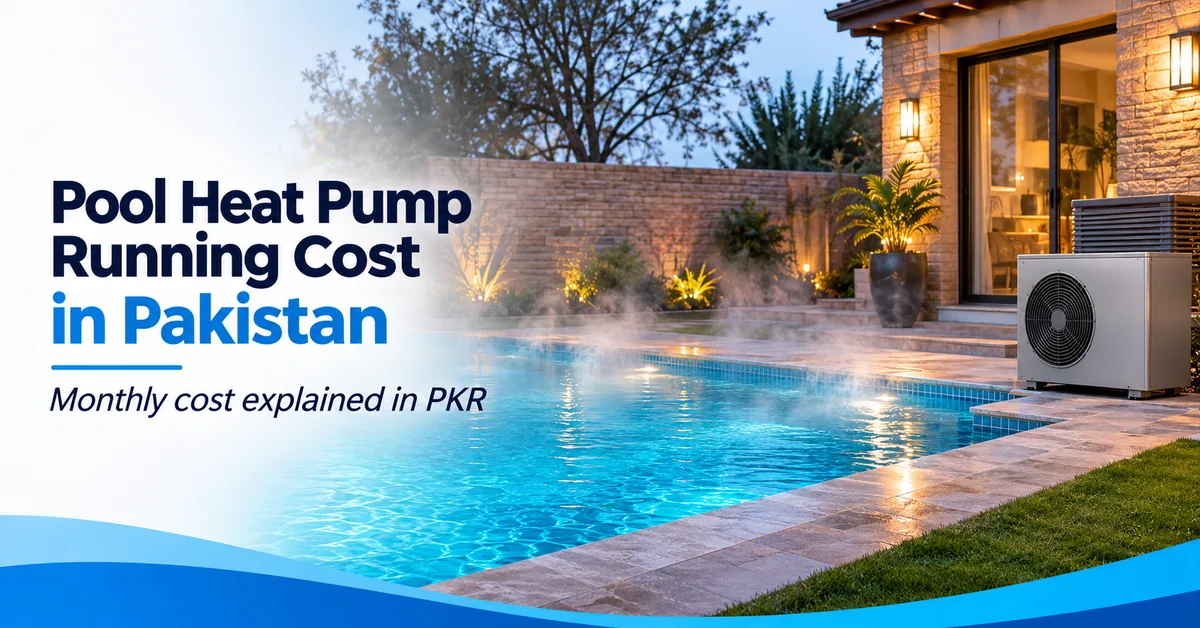
A typical 50 m³ home pool heated by an inverter heat pump uses roughly 480 to 800 units of electricity a month in a Lahore winter, which is about Rs23,000 to Rs38,000 at the current Rs47.69 base rate for homes using more than 700 units. The exact figure depends on your pool size, how many hours the heat pump runs, and whether you cover the pool at night.
That is the short answer. Below is how to work out your own number in five minutes, using the heater’s spec sheet and your electricity bill. If you would rather have it sized for you, see our swimming pool heating service in Lahore, where we match the heat pump to your pool’s water volume.
The simple formula for heat pump running cost
A pool heat pump does not make heat from electricity. It moves heat from the air into the water. That is why it uses far less power than a direct electric heater. The number that tells you how efficient it is, is the COP (coefficient of performance).
A COP of 5 means 1 unit of electricity puts about 5 units of heat into the water. So the formula is:
- Electricity used (kW) = heating output (kW) ÷ COP
- Units per month = electricity used (kW) × hours per day × 30
- Monthly cost (PKR) = units per month × your per-unit rate
You can find the heating output and COP on the manufacturer’s data sheet. Your per-unit rate is on your LESCO or IESCO bill.
Worked example: a 50 m³ pool in Lahore
A 10 m × 4 m pool with an average depth of 1.25 m holds about 50 m³ of water. It makes a useful example for a family pool at a city home.
A typical inverter heat pump rated for pools up to 50 m³ gives up to 15 kW of heat at 15°C air temperature with a COP of 5.6. So at full output it draws about 2.7 kW of electricity (15 ÷ 5.6).
We have used the January 2026 NEPRA base rate of Rs47.69 per unit for homes using more than 700 units a month. A heated pool usually pushes a large home into that slab. The hours below are example scenarios, not a fixed rule.
| Heater (50 m³ pool, 15°C air) | Hours per day | Units per month | Approx. cost per month |
|---|---|---|---|
| Inverter heat pump at full output (2.7 kW) | 6 | 482 | Rs22,990 |
| Inverter heat pump at full output (2.7 kW) | 8 | 643 | Rs30,660 |
| Inverter heat pump at full output (2.7 kW) | 10 | 804 | Rs38,320 |
| Inverter heat pump at low output, holding temperature (1.3 kW) | 8 | 313 | Rs14,920 |
| Direct electric heater, 12 kW (for a 40 m³ pool) | 8 | 2,880 | Rs137,350 |
Base energy rate only. GST, fuel price adjustment, fixed charges and other bill items are extra, so your real bill will be higher. Heater figures are typical manufacturer ratings.
The last row shows why we rarely recommend a direct electric heater for a full-size outdoor pool. The same 8 hours costs over four times more, because an electric heater has no COP advantage: 12 kW of heat takes 12 kW of electricity.
Why an inverter heat pump costs less to run
A standard (on/off) heat pump runs at full power until the water is warm, then switches off, then starts again. An inverter model slows down once the water reaches your set temperature and holds it there at lower power.
A 50 m³ inverter model can run at a lower output of 7.3 kW at 15°C air. At the same COP of 5.6, that is about 1.3 kW of electricity, half the full-power draw. Most of a winter month is spent holding temperature, not heating from cold, so this matters.
Compare an on/off model. A standard heat pump sized for a 45 m³ pool gives 12.9 kW at 15°C air with a COP of 3.8. That is about 3.4 kW of electricity, or around 815 units a month at 8 hours a day. For the same job, the inverter uses noticeably less.
What pushes your monthly bill up or down
- Air temperature. Heat pumps work harder in colder air. A standard heat pump’s COP drops from about 5.4 at 24°C air to about 4.1 at 15°C. On cold Lahore winter nights the air is often colder than 15°C, so run the heat pump in the warmest part of the day where you can.
- A pool cover. Manufacturer sizing figures assume a heat retention cover. Without one, an open pool loses much of its heat overnight and the heat pump has to start again every morning.
- Target temperature. Every extra degree takes more energy. Set a comfortable temperature and leave it there.
- Pool size and depth. More water needs a bigger heat pump or longer hours. Farmhouse pools on Barki Road or Bedian Road are often much bigger than city pools.
- Wind and shade. An exposed rooftop or farmhouse pool loses heat faster than a sheltered courtyard pool.
- Clean filter and servicing. Low water flow makes the heat pump work harder. Keep the filter clean.
How to estimate your own pool’s running cost
- Work out your pool volume: length × width × average depth (in metres) = m³.
- Find the heat pump’s heating output and COP at 15°C air on its data sheet. If you only have the figure at 24°C or more, expect real winter costs to be higher.
- Divide output by COP to get the electricity draw in kW.
- Multiply by the hours you expect it to run each day, then by 30.
- Multiply by the per-unit rate on your own electricity bill. If you have a time-of-use meter, use your off-peak rate for daytime running and check your bill for the peak rate.
Planning a new pool and want to see how heating changes the total price? Use our swimming pool cost calculator and choose heat pump under winter heating. To compare heat pumps with electric heaters and heat exchangers, read our guide to choosing the right pool heating system.
Frequently asked questions
How many units does a pool heat pump use per month in Pakistan?
For a 50 m³ pool, an inverter heat pump drawing about 2.7 kW at full power uses around 480 to 800 units a month if it runs 6 to 10 hours a day. Once the water is warm, an inverter model can hold temperature at roughly half that power. A pool cover cuts the hours it needs to run.
Is a heat pump cheaper to run than an electric pool heater?
Yes, for most outdoor pools. A heat pump with a COP of 5 gives about 5 units of heat for every unit of electricity, while a direct electric heater gives 1 for 1. In our example, 8 hours a day cost about Rs30,660 a month with a heat pump and about Rs137,350 with a 12 kW electric heater.
Which electricity rate should I use for a heated pool in Lahore?
Use the per-unit rate on your own LESCO bill. NEPRA’s base rate for domestic consumers using more than 700 units a month is Rs47.69 per unit for 2026, and a heated pool often takes a large home into that slab. Taxes and fuel adjustments are added on top.
How do I keep pool heating costs down in winter?
Cover the pool every night, set a sensible temperature, run the heat pump in the warmest hours of the day and keep the filter clean. Choosing an inverter heat pump sized to your pool volume also helps. Our pool heating team in Lahore can size one for your pool and check your existing pump and wiring.
Can I add a heat pump to my existing pool?
In most cases, yes. The heat pump connects to your existing filtration pipework. The pump, filter and electrical supply should be checked first, which we do during a site visit.
Want your pool heating sized and priced? Call or WhatsApp 0300 1116713. We install pool heat pumps across Lahore, from DHA and Gulberg to the Raiwind, Bedian and Barki farmhouses, and also work in Islamabad.