

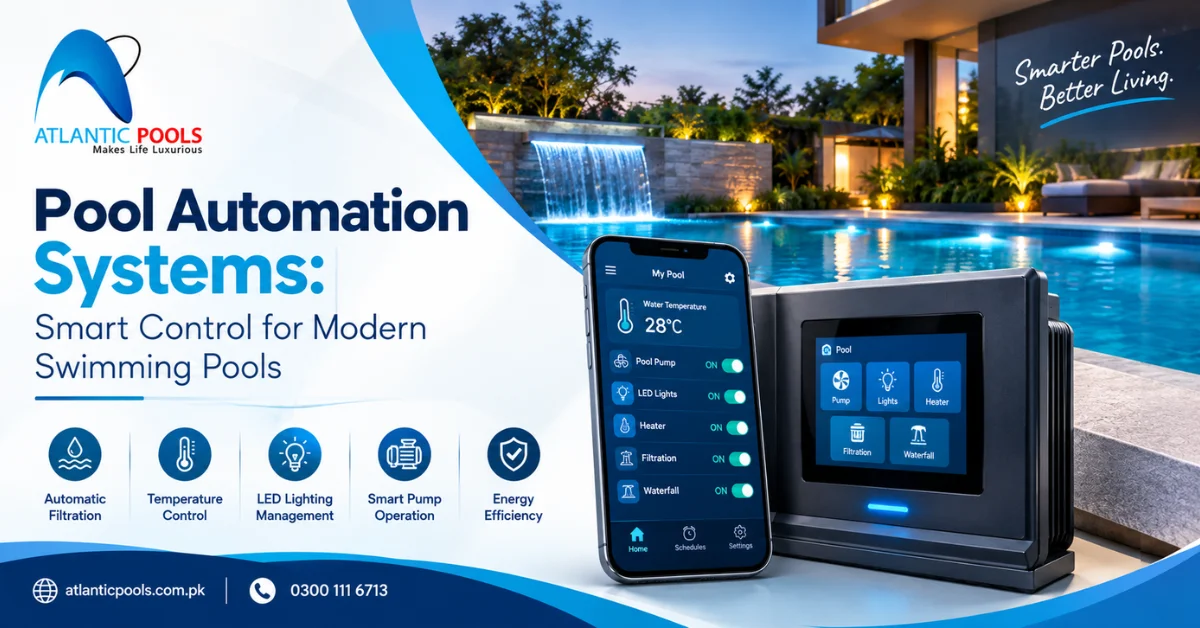
A few years ago, pool automation meant a single timer switch in the plant room that turned the pump on and off at set hours. Now it usually means an app on your phone that handles filtration schedules, heating, and lighting, and adjusts them based on actual conditions rather than a fixed clock. Pool automation systems have genuinely gotten better, but they’re still only as good as the equipment and plumbing behind them.
We get asked about this more often now as part of our regular equipment installation work, usually from clients who’ve seen a friend’s pool controlled entirely from a phone and want to know if it’s worth adding to their own.
Smart home adoption in Pakistan has been climbing steadily too, according to JS Technology’s coverage of the local market, which points to rising urbanisation and falling device prices as the main drivers. Pool automation is really just that same shift applied to one more part of the house.
What a Pool Automation System Actually Controls
At its core, a pool automation system replaces separate switches and timers with one central controller that talks to your pump, heater, lighting, and any water features. Instead of walking to the plant room to adjust filtration hours or turn on the pool lights manually, everything runs through a control panel or an app, and can follow a schedule that adjusts itself rather than staying fixed year-round.
Where It Actually Pays Off
The clearest benefit shows up when automation is paired with equipment that can actually respond to it, particularly a variable-speed pump. A fixed-schedule single-speed pump can’t take advantage of automation the way a variable-speed one can, since automation is largely about adjusting run time and speed based on actual conditions rather than a blanket schedule.
Heating follows the same logic. An automated system can hold water at a lower, energy-saving temperature overnight and bring it up before you actually plan to swim, rather than running a heater on a fixed schedule that doesn’t match how the pool is really used.
Pool Automation Features at a Glance
| Feature | What It Does | Best Paired With |
| Filtration scheduling | Adjusts run time based on usage and season | Variable-speed pump |
| Heating control | Pre-heats before use, drops overnight | Pool heater or heat pump |
| Lighting control | App or remote control of colour and schedule | LED pool lighting |
| Remote monitoring | Alerts for equipment issues or unusual readings | Any automated system |
What It Won’t Fix
Automation controls equipment, it doesn’t replace good pool construction underneath it. A pool with undersized filtration or poorly planned plumbing won’t perform better just because it’s controlled from a phone, the same underlying problems are still there, just easier to check on remotely.
Adding It to an Existing Pool vs a New Build
Automation is far simpler to plan into a new build than to retrofit later, since wiring and control panel placement can be designed in from the start rather than added around existing plumbing. That said, retrofitting is still possible on most pools, it just usually costs more and takes longer than including it in the original design.
This is also where wellness features come in. If a steam room or jacuzzi is part of the same project, it’s worth planning automation across all of it together rather than as separate systems added at different times, since a shared control setup is simpler to manage than three unrelated ones.
How We Approach This
We don’t push automation as an add-on to every project, it genuinely depends on the pool and how it’s used. Where it makes sense, we plan it in alongside the equipment we’re already sourcing, choosing compatible pumps, heaters, and lighting rather than bolting automation onto equipment that isn’t built to work with it.
Contact Us Now To Get A Free Quote!
Phone: +92 300 1116713
Final Thoughts
Pool automation systems are worth considering, but they’re an upgrade layered onto good construction and equipment, not a substitute for either. If your pool already has properly sized filtration and equipment that can actually respond to scheduling, automation is a genuinely useful addition. If it doesn’t, that’s the thing worth fixing first.
If you’re planning a new pool or thinking about adding automation to an existing one, get in touch with us and we’ll tell you honestly whether it’s worth it for your setup.
FAQs
What does a pool automation system actually control?
Typically filtration scheduling, heating, lighting, and sometimes water features, all managed from a central controller or an app instead of separate manual switches.
Does pool automation save money?
It can, mainly by running equipment like variable-speed pumps and heaters only when actually needed rather than on a fixed schedule, but the savings depend heavily on having equipment that’s actually capable of responding to automated scheduling.
Can automation be added to an existing pool?
Yes, though it’s usually more straightforward and less costly to plan it into a new build than to retrofit it onto an existing pool’s wiring and plumbing.
Do I need a variable-speed pump for automation to be worth it?
Not strictly, but automation delivers far less value with a single-speed pump, since there’s little for the system to actually adjust beyond an on/off schedule.
Can a steam room or jacuzzi be included in the same automation system?
Yes, and it’s usually worth planning together rather than as separate systems, particularly when they’re part of the same project.
Does Atlantic Pools install automation systems?
Yes, as part of our equipment planning where it makes sense for the project, choosing compatible pumps, heaters, and lighting rather than adding automation on top of equipment that isn’t suited to it.